Anaty (Desert Yam)
An exhibition of works by Aboriginal artist
Jeannie Mills Pwerle
February 19th - March 31st 2026
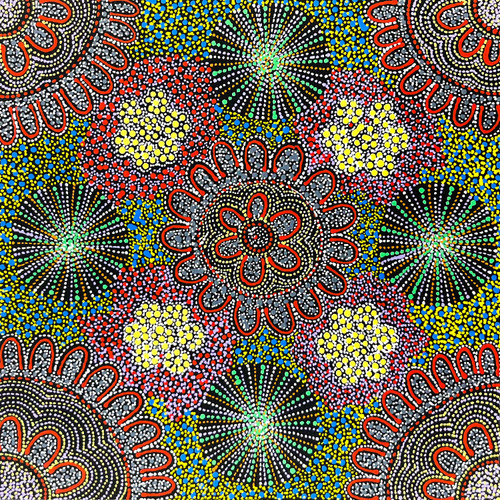
This exhibition celebrates the dynamic work of Jeannie Mills Pwerle, an Alyawarre woman from the Utopia region of Central Australia. Jeannie paints the Anaty (Desert Yam or Bush Potato, Ipomoea costata), pronounced 'a-NA-che', story from her father's country, Irrweltye, carrying forward important cultural knowledge through a style that is both deeply traditional and distinctly her own.
The Anaty grows underground as a nourishing tuber, while a viny shrub rises above ground up to one metre high. Found on spinifex sand plains, it produces large pink flowers after summer rain, transforming the desert landscape with vibrant colour. The tuber is a staple bush food for desert Aboriginal people and may be harvested year-round, with some growing as large as a person's head.
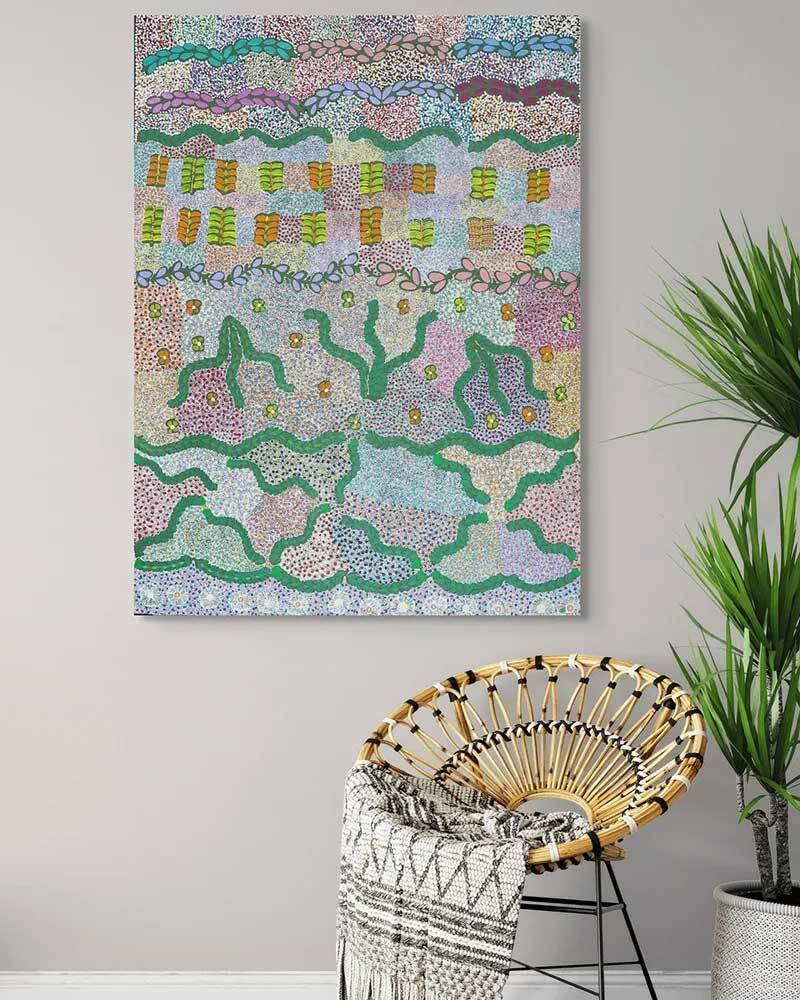
Jeannie predominantly paints the Anaty tuber itself, with the sweeping brushstrokes and fine dot work together representing the plant's life cycle - the tuber below ground, and the flowers and seeds above.
Loading her brush with three or four colours at once, she drags it across the canvas to form loose, layered bands of blended tones. Each stroke is slightly varied, creating a surface alive with movement and subtle shifts in colour - sometimes harmonious, sometimes boldly contrasting. She finishes by tracing the forms with countless tiny white dots, bringing clarity, rhythm and a shimmering energy to the work that draws the eye steadily across the painting.
Her distinct interpretation of the Anaty story was developed in 2004 for Mbantua Gallery, quickly gaining national recognition. In 2008, a large-scale Anaty painting was selected for the prestigious National Aboriginal and Torres Strait Islander Art Awards (NATSIAA), Australia's leading award for Aboriginal and Torres Strait Islander art.
Jeannie comes from a strong and respected painting family in Utopia. Her mother is Dolly Mills, her late uncle was Greeny Purvis Petyarre, and her great aunt was the internationally celebrated Emily Kame Kngwarreye (dec). She also spent many years painting alongside the late Ahalpere elder Lena Pwerle (dec), learning by watching and doing. Growing up surrounded by senior artists and cultural knowledge holders, Jeannie has developed into a confident and capable artist, proudly continuing her family's legacy while expressing her own interpretation of Country.
Cheerful and warm by nature, Jeannie is known for her genuine smile and quiet pride in sharing her knowledge of the bush. Though shy at first, she speaks with confidence when it comes to her work and teaching others about bush foods and medicine. Born in 1965 to a traditional healer, Jeannie has followed in her parent's footsteps and is now a respected healer herself.
For many years she lived in a small camp near the Utopia health clinic, a few hours north of Alice Springs. Tucked behind a line of old cars and known locally as 'Jeannie's camp', it reflected the regard people had for her and the role she played in the community. While she no longer lives there, people still travel long distances, at any hour, to seek her help. She keeps bush medicine prepared and ready, continuing her healing work alongside her painting practice.
Jeannie was overjoyed to hear that her works were being exhibited at Mbantua Gallery. She recently visited the Alice Springs gallery with family member Dulcie Pwerle, and together they were thrilled to see her paintings displayed so beautifully on the walls.
Both women shared how much it meant to them and spoke proudly about people from around the world coming to learn more about Jeannie's story and what it represents for her and her people.
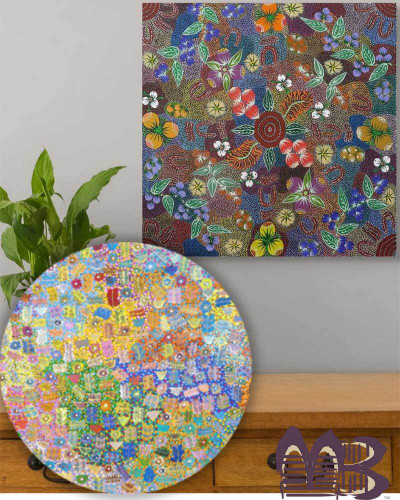
We hope you've enjoyed learning more about Jeannie, the Anaty, and the meaning this story holds for her and her family. We invite you to take your time exploring the paintings in this exhibition. You can view the full collection online below or visit our Darwin or Alice Springs galleries to see them up close.
*Please note that all works are available for purchase unless marked as sold and will remain on display until the exhibition concludes on 31st March. Purchased works can then be collected or carefully packed and sent to you by our friendly team.