



Artwork Story
Minnie paints Awelye (Women's Ceremonial and Body Paint Designs) for the ancestral dreamtime stories which belong to her country, Atnwengerrp.
Linear designs represent Awelye. These designs are painted onto the chest, breasts, arms and thighs. Powders ground from red and yellow ochre (clays), charcoal and ash are used as body paint and applied with a flat stick with soft padding. The women sing the songs associated with their Awelye as each woman takes her turn to be 'painted-up'. Women perform Awelye ceremonies to demonstrate respect for their country and the total well-being and health of their community.
Minnie Pwerle
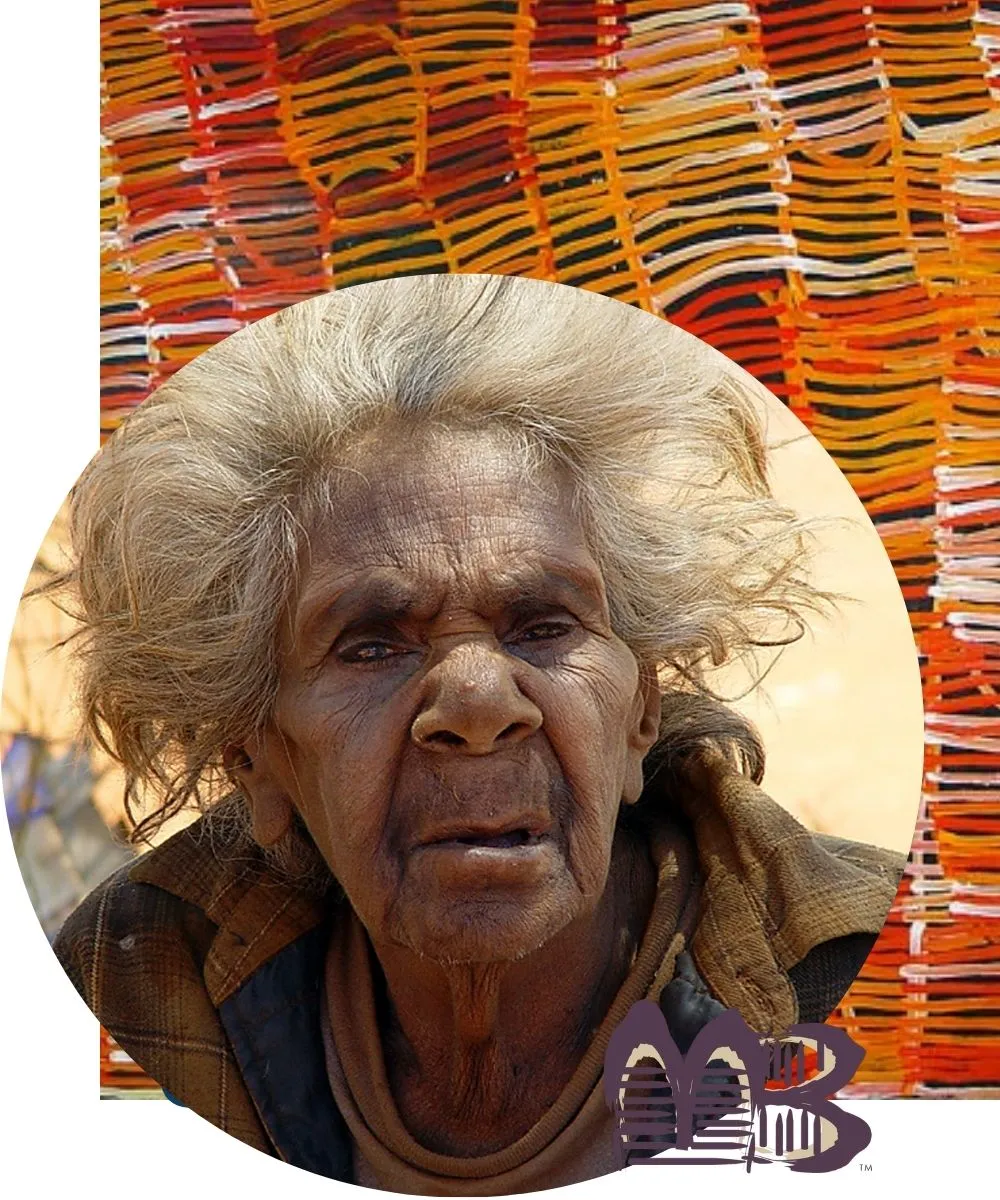
c. 1922
Deceased:2006
Language Group:Alyawarre
Country:Atnwengerrp, Utopia Region, North East of Alice Springs, Northern Territory
Medium:Acrylic on Canvas and Linen
Subjects:Awelye (Women's Ceremony), Anemangkerr (Bush Melon) Dreaming, Akarley (Northern Wild Orange), Awelye (Women's Ceremony) for Anemangkerr (Bush Melon)
Minnie Pwerle (c.1922-2006), also known as Minnie Motorcar, was an Alyawarre artist connected to Atnwengerrp Country in the Utopia region of Central Australia. Minnie was one of the respected Pwerle Sister artists and became internationally recognised after beginning her painting journey later in life in 2000. Encouraged by her daughter and artist the late Barbara Weir, Minnie painted the stories and designs she had always known, bringing the traditional Awelye (women's ceremony and body paint designs) of her Country onto canvas.
Her paintings reflect some of the oldest Aboriginal artistic traditions, with flowing linear designs inspired by ceremonial body painting. These designs represent respect for Country, community wellbeing and the continuation of cultural knowledge passed through generations.
Working in acrylic on canvas and linen, Minnie also painted Anemangkerr (small melon) and Akarley (Bush Orange) Dreamings. Her bold, energetic brushwork and vibrant use of colour created a unique style that combined ancient stories with a striking contemporary expression.
Although she had never received formal European art training, Minnie became one of Australia's most celebrated contemporary Aboriginal artists. Her paintings continue to be admired around the world for their powerful connection to culture, Country and tradition.
COLLECTIONS
AMP Collection, Melbourne, VIC
COLLECTIONS
Artbank, Sydney, NSW
COLLECTIONS
Art Gallery of South Australia, Adelaide, SA
COLLECTIONS
Art Gallery of New South Wales, Sydney, NSW
COLLECTIONS
Art Gallery of Western Australia, Perth, WA
COLLECTIONS
Australian Heritage Commission, Canberra, ACT
COLLECTIONS
Hank Ebes Collection, Melbourne
COLLECTIONS
The Kelton Foundation, Santa Monica, USA
COLLECTIONS
Kreglinger Collection, Melbourne, VIC
COLLECTIONS
Mbantua Gallery Collection, Alice Springs, NT
EXHIBITIONS
EXHIBITIONS
EXHIBITIONS
EXHIBITIONS
EXHIBITIONS
EXHIBITIONS
EXHIBITIONS
EXHIBITIONS
EXHIBITIONS
EXHIBITIONS
EXHIBITIONS
EXHIBITIONS
EXHIBITIONS
EXHIBITIONS
EXHIBITIONS
EXHIBITIONS
EXHIBITIONS
EXHIBITIONS
EXHIBITIONS
EXHIBITIONS
EXHIBITIONS
EXHIBITIONS
EXHIBITIONS
EXHIBITIONS
EXHIBITIONS
EXHIBITIONS
EXHIBITIONS
EXHIBITIONS
EXHIBITIONS
EXHIBITIONS
- Artist Name:
- Minnie Pwerle
- Artwork Size:
- 60 x 60cm
- Medium:
- Acrylic on Linen
- Year Painted:
- 2004
- Title:
- Awelye (Women's Ceremony)
- Free Shipping Worldwide!:
- This painting on linen will be shipped in a cylinder to you free of charge, worldwide! An option to have this painting 'stretched' onto a wooden frame may be available. If selected, further charges will apply and will be calculated at checkout.


