



Aboriginal Symbols
Understanding Aboriginal Symbols in Art
Aboriginal Art and Symbols
Aboriginal symbols are visual elements used in artworks to represent people, animals, landmarks, water sources, journeys and other important aspects of life on Country. While some symbols are widely recognised across many regions, their meanings can vary between different Aboriginal language groups and communities.
When combined within a painting, symbols help tell stories, share cultural knowledge and depict connections to Country, Dreaming stories and traditional ways of life. Symbols have been passed down through generations and can hold deep spiritual, cultural and practical meanings, often connected to the environment, ancestral beings and traditional practices.
The interpretation and use of symbols can differ according to the region, language group, family and cultural context. A symbol that has one meaning in one community may have a different meaning elsewhere. Aboriginal artists use these visual elements to communicate stories and knowledge in ways that are connected to their own Country and cultural traditions.
Common Symbols
Arcs or semi-circles can represent elements of the landscape, natural features or cultural places. They may symbolise caves, shelters or places where people gather for protection, rest or ceremony.
Straight lines can represent paths, journeys, watercourses or other features of the landscape. They may depict travel routes or the paths taken by people, animals or ancestral beings across Country.
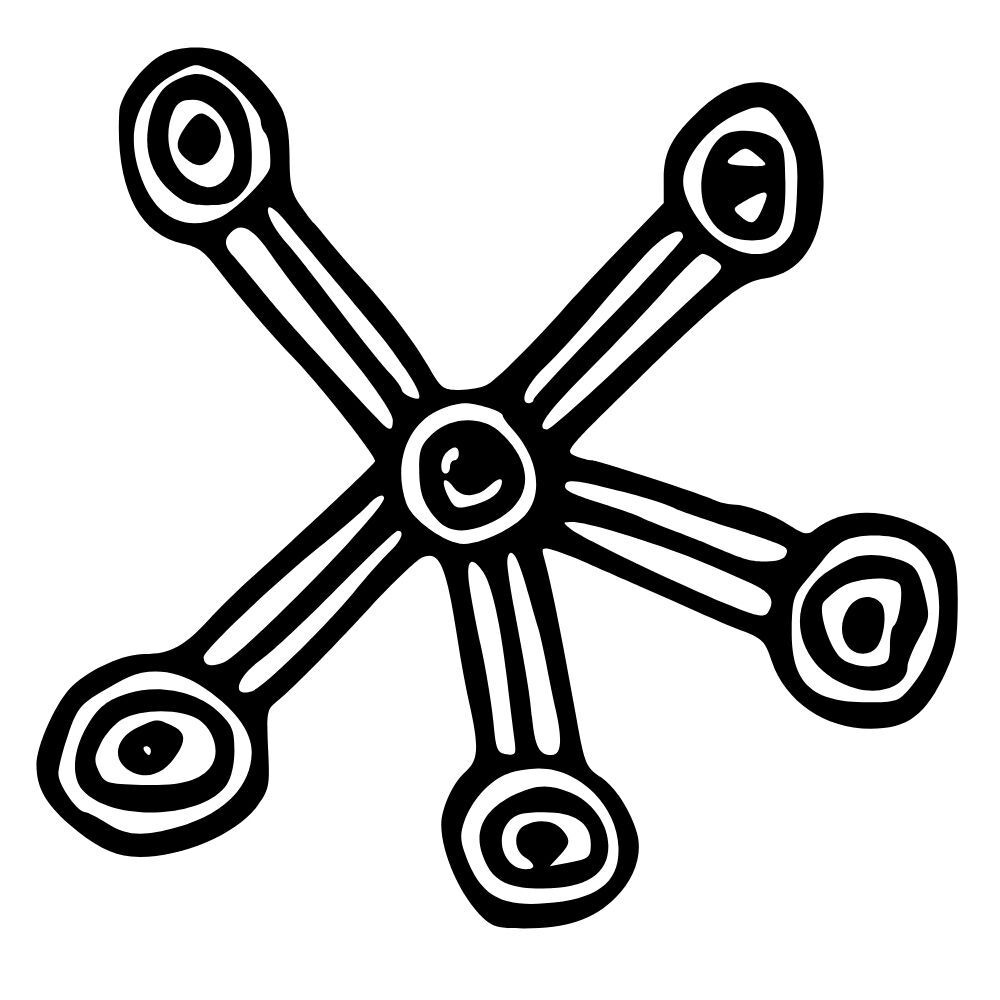
Concentric circles are commonly used in Aboriginal art and can represent important places such as waterholes, campsites or other significant locations. The meaning of the circles depends on the artist, community and story being depicted, and may also represent movement, journeys, water or connections between people and places.
People
People may be represented in a variety of ways depending on the artist, region and cultural context. Common representations can include:
- U-shape - A U-shaped symbol is commonly used to represent a person sitting on the ground. Objects placed alongside the figure, such as a coolamon, digging stick, spear or boomerang, may provide further context about the person or activity being depicted.
- Human figures - People may be represented using simple geometric shapes or lines, with additional marks used to suggest the head, body, arms and legs.
- Footprints or tracks - A series of marks can represent the tracks or journey of a person moving across Country.
- Ceremonial designs - Lines, circles and other patterns may represent ceremonial practices, body painting or cultural knowledge. Their meanings are specific to the cultural context in which they are used.
Animals
For Aboriginal artists from the Utopia region, animals are often represented by the tracks or marks they leave behind on Country. These representations can vary between artists and cultural groups.
- Kangaroo - A series of U-shaped marks or tracks can represent the movement of a kangaroo across the land.
- Snake - Wavy or curved lines can represent a snake and its movement across Country.
- Emu - Emu tracks may be represented by distinctive three-toed marks or lines that suggest the movement of the bird across the landscape.
- Goanna - Zigzag, curved or wavy lines can be used to represent a goanna or lizard and its movement through the environment.
It is important to remember that Aboriginal symbols do not have one universal meaning. Their interpretation is connected to the artist, their Country, language group, family and cultural knowledge. The symbols within an artwork work together to communicate stories and relationships with Country, rather than simply representing individual objects.